.png)
The Real Reason Practices Switch to an AI Medical Receptionist (It’s Not What You Think)

The Takeaway:
Practices switch to an AI medical receptionist not because of front-desk burnout, but because answered calls still fail to become correctly captured appointments. A Voice AI receptionist closes that gap by booking directly into the practice's EHR or practice management system.
By mid-morning, most front desks in medical practices are already behind. Calls for appointment rescheduling are stacked up behind walk-in check-ins and time-sensitive pharmacy requests, and some calls inevitably go to voicemail. This is the operational reality practice leaders point to when they describe why they began evaluating an AI medical receptionist.
There are too many calls for too few hands, and the team is stretched thinner every month.
While that explanation is accurate, it is also incomplete. Burnout describes what a front desk feels on a difficult morning, but it does not explain why some practices reach a breaking point while others, facing the same call volume and the same staffing pressures, do not.
The Assumed Reason: Burnout
Among practice managers evaluating an AI medical receptionist, burnout is consistently the first reason raised, and it is a legitimate one. MGMA's most recent staffing survey found that 53% of medical group leaders cite finding qualified candidates as their top staffing challenge, and 16% of these leaders point to retention as their biggest challenge.
Front-desk and medical assistant roles absorb much of that pressure. The demands of the job, including handling patient calls, managing appointments, and keeping daily operations running smoothly, have pushed many of these employees toward telehealth or administrative roles that offer more flexibility. The broader shift toward remote healthcare work has widened that option considerably, giving experienced staff even more places to go.
This turnover creates a compounding cycle of staff leaving, replacements taking weeks to reach full productivity, and the remaining team absorbing the shortfall, often at the cost of call quality and patient wait times.
The pressure is real, and it is understandable that many leadership teams treat it as the primary driver behind a technology change. Yet staffing strain, on its own, does not fully account for the timing of a switch. Many practices manage through a difficult hiring cycle, stabilize their teams, and continue operating the same phone system for years afterward.
Something more specific to the practice's revenue and patient experience is usually behind the decision to act.
The Real Reason: The Revenue Gap Between Answered and Captured Calls
The deeper problem shows up after a call has already been handled.
A patient calls, someone picks up, the conversation goes fine, and an appointment is promised.
What does not always happen cleanly is if that appointment lands in the correct slot with the correct provider, and is documented cleanly to the practice’s scheduling system. A single manual entry error at that stage, like a wrong time, a mismatched appointment type, or a provider swapped by mistake, is often enough to lose the appointment entirely, even though the call itself went smoothly.
Most front desks measure whether a call was answered, not whether it converted into a correctly captured appointment. A call log can reflect a strong answer rate on a given day and still hide a meaningful volume of bookings that never reached the schedule accurately. Calls can be handled competently by every visible measure but still fail to convert into revenue because the booking step lost accuracy between the phone and the schedule.
Most scheduling still depends on manual processes rather than a documented system. In an MGMA-fielded survey of 359 practice executives, 84% reported that patients still book primarily at the front desk, and 86% reported relying on staff memory or informal notes, rather than a documented system, to manage scheduling rules. Each manual handoff introduces a point at which a double-booking, an incorrect provider assignment, or a slot that never reaches the practice management system can occur. Across dozens of calls a day, that exposure indefinitely compounds. A practice can answer every call it receives and still lose patients, along with the revenue attached to them, that it should have retained.
Switching to an AI Medical Receptionist
This is usually where hesitation surfaces among practice leadership. The prospect of switching evokes an image of removing an entire phone system and retraining staff over a single weekend.
However, it is not how most practices actually adopt a Voice AI receptionist. It does not outright replace the front desk, in contrast to most perceptions. The common path has a structured pilot, one phone line, one location, or a defined evaluation window, run alongside the existing front desk. This approach allows practice leadership to assess performance under real conditions before committing to a broader rollout, and to step back quickly if the results fall short of expectations.
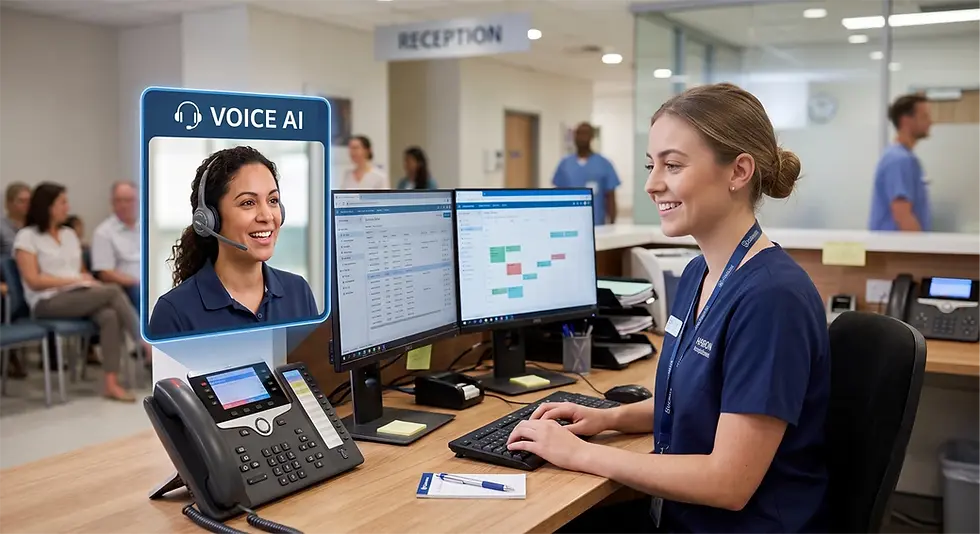
An accuracy-first AI medical receptionist, like Aidion Health’s Voice AI, is built to operate within that lower-risk framework. It answers every call, confirms the correct appointment type, and writes the booking back into your EHR or practice management system the way a trained staff member would. It does not require a long-term contract or a full workflow rebuild to demonstrate value. It also runs within a HIPAA-compliant environment from the outset, which matters to a compliance officer in the same way accuracy matters to a practice manager.
Implemented well, it does not function as a wholesale replacement of the front desk. It operates as an additional, always-available team member, one that sounds human-like to the patient on the phone and stays precise in what it records behind the scenes.
What Changes with an AI Medical Receptionist
In this context, the clearest sign a practice made the right call is not only with call volume. It is what happens to the schedule afterward, since call volume alone says nothing about whether those calls turned into revenue.
Practices that switch to a Voice AI receptionist to capture calls typically see a few specific changes:
More answered calls convert into correctly booked, billable appointments, rather than into promises that never make it onto the schedule.
Fewer scheduling errors resurface later as a no-show or a billing correction, since the appointment is captured accurately the first time.
Front-desk and clinical staff spend less time on manual EHR entry and callback cleanup, and more time with patients already in the building.
Practice leadership gains a clear, reviewable record of what happened on each call, the appointment type, the provider assigned, and the outcome.
None of this requires a claim about every error disappearing, and it should not. A HIPAA-compliant AI medical receptionist that reduces manual booking mistakes and returns time to front-desk staff is a realistic outcome. It does not promise that every gap closes overnight, but measurably reduces the gaps that occur in the first place.
Where This Leaves You
Burnout is what practices notice first. But the gap between a call getting answered and an appointment actually getting captured is usually what pushes them to act, because it marks the difference between a front desk that feels responsive and one that actually converts that responsiveness into revenue for the practice.
If your team is answering every call and you're still not sure where the gaps in your schedule are coming from, it's worth a closer look. Visit Aidion Health to see how our Voice AI fits a practice like yours, or schedule a demo to walk through what closing that gap could look like for your practice.
Frequently Asked Questions (FAQs)
1. Why do practices switch to an AI medical receptionist?
Most say it's front-desk burnout, but the deciding factor is usually revenue: calls that get answered but are never converted into a correctly booked, EHR-synced appointment.
2. Can a medical practice lose revenue even when every call is answered?
Yes. A call can be handled correctly and still fail to convert into revenue if the appointment isn't booked accurately or written back to the schedule, a common gap in manual scheduling processes.
3. Do practices have to replace their entire front desk to use a Voice AI receptionist?
No. Most vendors, like Aidion Health, start with a focused pilot, a single location or call type, running alongside the existing front desk before expanding into broader scheduling or outbound workflows.
4. Is an AI medical receptionist HIPAA compliant?
Yes. A properly built Voice AI receptionist, like Aidion Health’s Voice AI, operates within a HIPAA-compliant environment from the outset, handling patient calls and scheduling data under the same privacy standards required of any healthcare system.